
Laos is known for its gracious hospitality, enduring Buddhist traditions, and unhurried approach to daily life. From the temple-lined streets of Luang Prabang to villages along the Mekong River, courtesy and consideration remain central to social interactions.
International visitors are not expected to understand every local custom. Still, learning a few traditions before arriving can help you travel with greater confidence, avoid unintended misunderstandings, and engage more meaningfully with the people and places you encounter.
Courtesy and Social Harmony
Lao culture places great importance on patience, humility, and maintaining harmony in social situations. Raised voices, visible anger, and confrontational behavior are generally considered inappropriate, particularly in public.
Even when plans change or service moves more slowly than expected, a calm and good-humored response is usually the most effective approach. The commonly heard expression “baw pen nyang”—roughly meaning “no problem” or “never mind”—reflects a broader willingness to accept minor inconveniences without unnecessary conflict.
This relaxed outlook should not be mistaken for indifference. Rather, it reflects a culture in which personal relationships, dignity, and social balance often take precedence over urgency.
Greetings
The everyday Lao greeting is “sabaidee,” usually accompanied by a smile. In more formal situations, people may use the nop, placing the palms together near the chest with a slight bow.
A handshake is also common in professional settings and when meeting international visitors. Returning the greeting offered to you is always appropriate, although physical contact between men and women may be more reserved than in many Western cultures.
When addressing elders, monks, or people in positions of authority, a slightly more formal and deferential manner is appreciated.
Removing Shoes
Shoes are commonly removed before entering private homes, temple interiors, and certain traditional accommodations or businesses. A collection of footwear near an entrance is usually a clear indication that you should do the same.
Avoid stepping directly on thresholds when entering traditional buildings, and wait until you are fully outside before putting your shoes back on. Wearing footwear that can be removed easily is particularly helpful when exploring the temples of Luang Prabang and other historic communities.
Dress and Modesty
Laos remains relatively conservative in matters of dress, especially in rural communities and religious settings. Lightweight clothing is practical in the tropical climate, but shoulders and knees should be covered when visiting temples.
Swimwear should be reserved for hotel pools and designated swimming areas. When walking through villages, markets, or city neighborhoods, modest clothing demonstrates consideration for local customs.
A light scarf or wrap can be useful for temple visits, although travelers should not assume that loosely covering the shoulders will always satisfy entrance requirements. Wearing an appropriate shirt and knee-length or longer trousers, skirts, or dresses is the most respectful approach.
Temples and Sacred Places
Theravada Buddhism plays an important role in Lao culture, and temples remain active centers of worship, education, and community life.
When visiting a temple:
- Remove your shoes and hat before entering interior spaces.
- Dress with shoulders and knees covered.
- Speak quietly and silence mobile devices.
- Avoid touching statues, altars, or religious objects.
- Do not climb on sacred structures or pose disrespectfully with Buddha images.
- Ask permission before photographing monks or worshippers.
- Never point your feet toward a Buddha image, monk, or altar.
When sitting inside a temple, kneel or sit with your legs folded to the side so that the soles of your feet do not face the shrine.
Monks
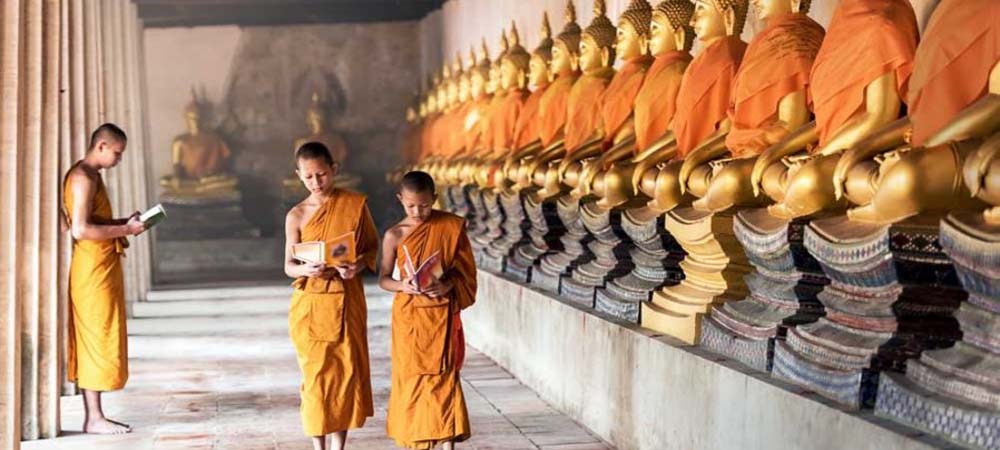
Monks are highly respected members of Lao society. Visitors may speak with monks when invited, but interactions should remain courteous and mindful of monastic customs.
Women should not touch a monk or hand an object directly to him. An item can instead be placed on a table or passed through a male intermediary. On public transportation or in waiting areas, women should also avoid sitting immediately beside a monk when other seating is available.
If a monk is seated, try not to stand directly over him during a conversation. Following his lead and maintaining a respectful distance is generally the best approach.
Morning Almsgiving in Luang Prabang
The morning almsgiving ceremony, known as tak bat, is one of Luang Prabang’s most recognizable traditions. At dawn, monks walk quietly through the streets to receive food offerings from members of the local community.
This is a religious observance rather than a staged attraction. Visitors are welcome to observe, but should remain silent, maintain a respectful distance, avoid flash photography, and never interrupt the procession for photographs.
Travelers should participate only when they understand the ceremony and can do so respectfully. Appropriate dress is essential, shoes are removed when presenting an offering, and food should ideally be arranged through a knowledgeable guide or local host rather than purchased from opportunistic vendors along the route.
Heads, Feet and Body Language
Traditional beliefs influence how different parts of the body are regarded.
The head is considered the highest and most respected part of the body, so avoid touching another person’s head, including that of a child.
The feet are regarded as the lowest part of the body. Avoid pointing them toward people, religious images, or sacred objects, and do not place them on furniture. Stepping over another person, food, or personal belongings is also considered disrespectful.
When indicating a person or object, gesture with an open hand rather than pointing directly with one finger. To beckon someone, hold your hand with the palm facing downward and move the fingers gently toward yourself.
Giving and Receiving
When offering or receiving gifts, documents, money, or other items, using both hands—or the right hand supported by the left—is a courteous gesture.
Small gifts may be appreciated when visiting a home or community, but they should be offered discreetly rather than distributed indiscriminately. Gifts for children are generally best coordinated through a guide, school, or established community organization.
Expressions of thanks are always welcome. The Lao phrase “khop jai” means “thank you,” while “khop jai lai lai” conveys deeper appreciation.
Dining Etiquette
Lao meals are often communal, with several dishes shared among the table. Sticky rice is a staple and is traditionally eaten by forming a small portion into a ball with the fingers before using it to gather other foods.
Wait for your host or guide to indicate when the meal is beginning, and take modest portions from shared dishes. Serving utensils should be used when provided.
If invited into a private home, accept at least a small amount of food or drink when practical, as hospitality is offered sincerely. Complimenting the meal and thanking the host are simple ways to show appreciation.
Public Behavior and Personal Affection
Public behavior in Laos tends to be restrained. Loud conversation, aggressive bargaining, and conspicuous displays of frustration can make others uncomfortable.
Public displays of affection are generally more reserved than in many Western countries, particularly outside the main tourism centers. Holding hands is unlikely to attract concern, but more intimate behavior is best kept private.
Visitors should also ask permission before photographing individuals, particularly monks, children, artisans, and residents of rural or ethnic minority communities.
Markets and Bargaining
Public behavior in Laos tends to be restrained. Loud conversation, aggressive bargaining, and conspicuous displays of frustration can make others uncomfortable.
Public displays of affection are generally more reserved than in many Western countries, particularly outside the main tourism centers. Holding hands is unlikely to attract concern, but more intimate behavior is best kept private.
Visitors should also ask permission before photographing individuals, particularly monks, children, artisans, and residents of rural or ethnic minority communities.
Markets and Bargaining
Bargaining is accepted in some markets, but it should remain friendly and proportionate. Not every price is negotiable, particularly in fixed-price shops, restaurants, or businesses selling locally made handicrafts.
A smile and relaxed conversation are more effective than aggressive negotiation. Remember that a small difference in price may carry greater significance for a local vendor than it does for an international visitor.
Whenever possible, purchasing directly from artisans and community enterprises helps support the continuation of traditional weaving, carving, papermaking, and other Lao crafts.
Conversations About Politics and History
Laos has a complex modern history, and political discussions should be approached with discretion. Visitors should avoid criticizing the government or initiating sensitive conversations with people they have only recently met.
The effects of past conflicts also remain visible, particularly through the continuing presence of unexploded ordnance in some rural regions. Travelers should stay on established roads and marked paths and follow the advice of their guides when visiting the countryside.
Historical museums and interpretation centers offer appropriate settings in which to learn more about these subjects without placing local residents in an uncomfortable position.
Responsible Travel
Laos is home to numerous ethnic communities, each with its own languages, clothing, beliefs, and social traditions. Village visits should be approached as opportunities for respectful cultural exchange rather than observation alone.
Follow your guide’s direction, request permission before entering homes or photographing residents, and avoid giving money or sweets directly to children. Supporting locally operated workshops, markets, restaurants, and community projects generally creates a more positive and sustainable form of engagement.
Final Thoughts
Understanding a few basic customs allows travelers to experience Laos with greater ease while showing respect for the traditions that continue to shape everyday life. From observing morning alms in Luang Prabang to entering a village home or sharing a meal beside the Mekong, patience, modesty, and genuine courtesy will always be appreciated.
For a broader introduction to the country, explore our Laos Travel Guide, featuring its principal destinations, cultural highlights, and seasonal travel considerations. Travelers ready to begin planning can also browse our collection of Laos Tours, including Luang Prabang Highlights and our privately guided Indochina journeys combining Laos with Vietnam, Cambodia, or Thailand.