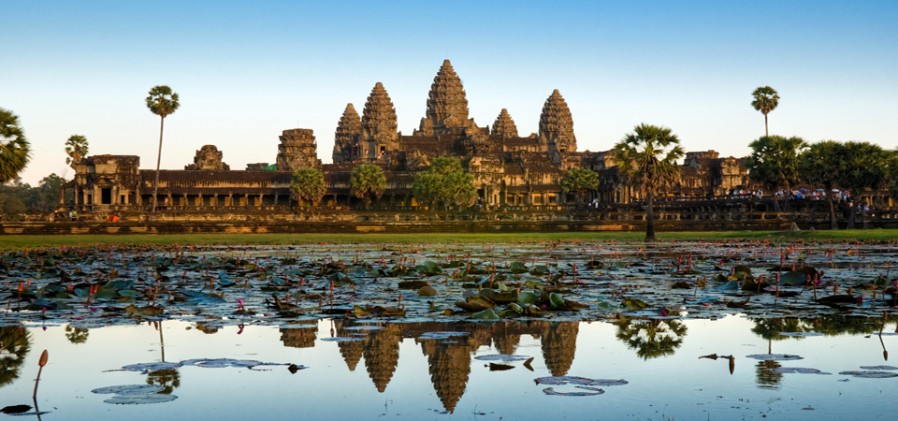

Built in the first half of the 12th century by King Suryayarman II, Angkor Wat is the largest religious monument ever constructed in the history of mankind and is arguably the most beautiful and impressive historical edifice. Its magnificence and mightiness surpass that of the Pyramids and its artistic beauty rivals that of the Taj Mahal.
Wat means temple in Khmer and Angkor is capital city so Angkor Wat simply means Capital City temple. Revered as national treasure and fiercely pride by the Khmer, Angkor Wat is pictured on the Cambodian national flag and the Cambodia currency. An architectural masterpiece, Angkor Wat is the best preserved and is the largest monument of the Angkor structures group. Historians, scholars and archeologists still aren’t quite sure for what purpose Angkor Wat was built; whether it is a temple, shrine, mausoleum or observatory. Khmer generally accepts it as a funerary temple for King Suryayarman II. Traditionally, Hindu temples had their main entrance to the east. The fact that Angkok Wat’s main gate is to the west conforms to the symbolism associated with the sun setting and death. The bas-reliefs were designed to be viewed from left to right in the order of a Hindu funeral ritual further supports the funerary claims.

Originally built to dedicate to the Hindu gods Shiva and then Vishnu, a symbolic representation of Hindu cosmology, Angkor Wat was later transformed into a Theravada Buddhist monument by the end of the 13th century and remains so into present day. Angkor Wat is admired for the harmony of its design and for the grandeur of its architecture. A few things had been said about this magnificent temple.
A Portuguese monk named Antonio da Madalena, one of the first Westerner to visit Angkor in 1586 said that the temple is “of such extraordinary construction that it is not possible to describe it with a pen, particularly since it is like no other building in the world. It has towers and decoration and all the refinements which the human genius can conceive of”

A mid-20th-century conservator of Angkor name Maurice Glaize said the temple “attains a classic perfection by the restrained monumentality of its finely balanced elements and the precise arrangement of its proportions. It is a work of power, unity and style.”
Frank Vincent, JR., an American who visited Angkor in 1872 said in his book The Land of the White Elephant: Sound and Scenes in South Eastern Asia that “the wonder of the temple is beautiful and romantic as well as impressive and grand it must be seen to be understood and appreciated. One can never look upon the ensemble of the vat without a thrill, a pause, a feeling of being caught up onto the heavens. Perhaps it is the most impressive sight in the world of edifices.”

A French explorer and scientist named Henri Mouhot visited Angkor in 1860 and wrote about Angkor Wat in his diary, which later were published as a book with the title Travels in Siam, Cambodia and Laos. In it he wrote “Even just a glimpse of the buildings at Angkor is stunning…. They are ruins of such grandeur… that, at the first view, one is filled with profound admiration, and cannot but ask what has become of these powerful [people], so civilized, so enlightened, the authors of these gigantic works”
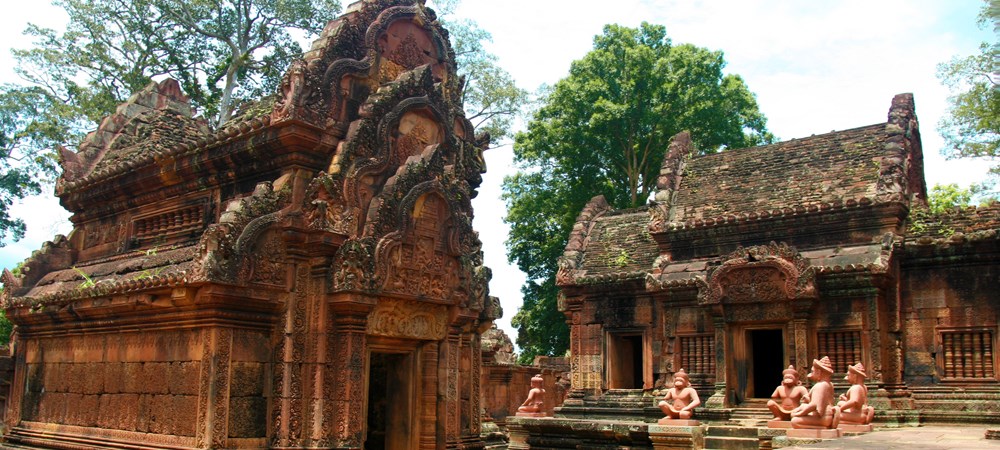
In 1992, Angkor Wat was made a UNESCO World Heritage site. Today, Angkor Wat has become a major tourist destination with over 2 million foreign visitors each year. So much has been written about Angkor Wat but there are a few things about this magnificent monument that may still surprise you.
- The temple was estimated to have built over a 30 year span. Six to ten million blocks (over five million tons of sandstone) was quarried and transported 25 miles to the temple. In fact, the entire city of Angkor used up far greater amounts of stone than all the Egyptian pyramids combined.
- As grand as it is and though the Cambodian tourism would have liked it to be, Angkor Wat didn’t make it to the list of the Seven Wonders of the World – Ancient or Modern.
- Though a few bullet holes were put in a bas relief in a shoot-out between Khmer Rouge and Vietnamese forces and a pavilion was ruined by a stray American shell, far more damage was done by art thieves, unregulated tourism and looting. Many ancient statues were decapitated and sold to private collectors.
- While considered as a mausoleum for King Suryavarman II by the Khmer, his body was never buried at Angkor Wat as he died in battle during a failed expedition to subdue the Dai Viet (Vietnamese). Angkor Wat appears to have been completed only after his death.
- For over 30 years since 1990, the Angkor complex was managed by the private enterprise SOKIMEX and tickets sold were not received by the government of Cambodia. Only about 28% of the profit went back to maintaining the temples. In 2016, it was decided that the government will take over full control of management of the complex.
- Though the temple is known to have been built to dedicate to the Hindu gods Shiva & Vishnu and was meant to be the mausoleum for King Suryavarman II, it is postulated that there may have been another reason why Angkor Wat was built. In his book To Cambodia with Love, Kent Davis claims that there are 1,795 women carved into the stone at Angkor Wat alone, making them the real subject of the temple. It is said that these carvings are in fact portraits of the very women who lived here and perhaps these women were the driving force behind the Khmer civilization.
- Though now serves as a Buddhist temple, Angkor Wat today in inhabited. Contrary to common perception, no Buddhist monks live here.
- It has been more than a century since the initial research of Angkor Wat. Most was done on the parts of the temple that are visible with the naked eye. It is believed that the site was a sacred city contained within the bounds of the square moat. In December 2015, a research team from the University of Sydney announced it had found other structures buried beneath that were not previously discovered. Using a technology known as LiDAR, and a technique called light detection and ranging, the team discovered that this gigantic temple is connected to residential districts, canals and other structures that stretched beyond the moat, suggesting that Angkor Wat was not a sacred city after all.
- The findings in 2015 also revealed multiple cities between 900 and 1,400 years old beneath the tropical forest floor, some of which rival the size of Cambodia’s capital, Phnom Penh. Some experts believe that the recently analyzed data, covering 734 sq miles, shows that the colossal, densely populated cities would have constituted the largest empire on earth at the time of its peak in the 12th century.
Explorient offers a array of tour packages featuring Siem Rean and Angkor Wat. For travel ideas on Cambodia and other Southeast Asia destination, please check out our Cambodia, Laos & Myanmar Vacations page for details.